
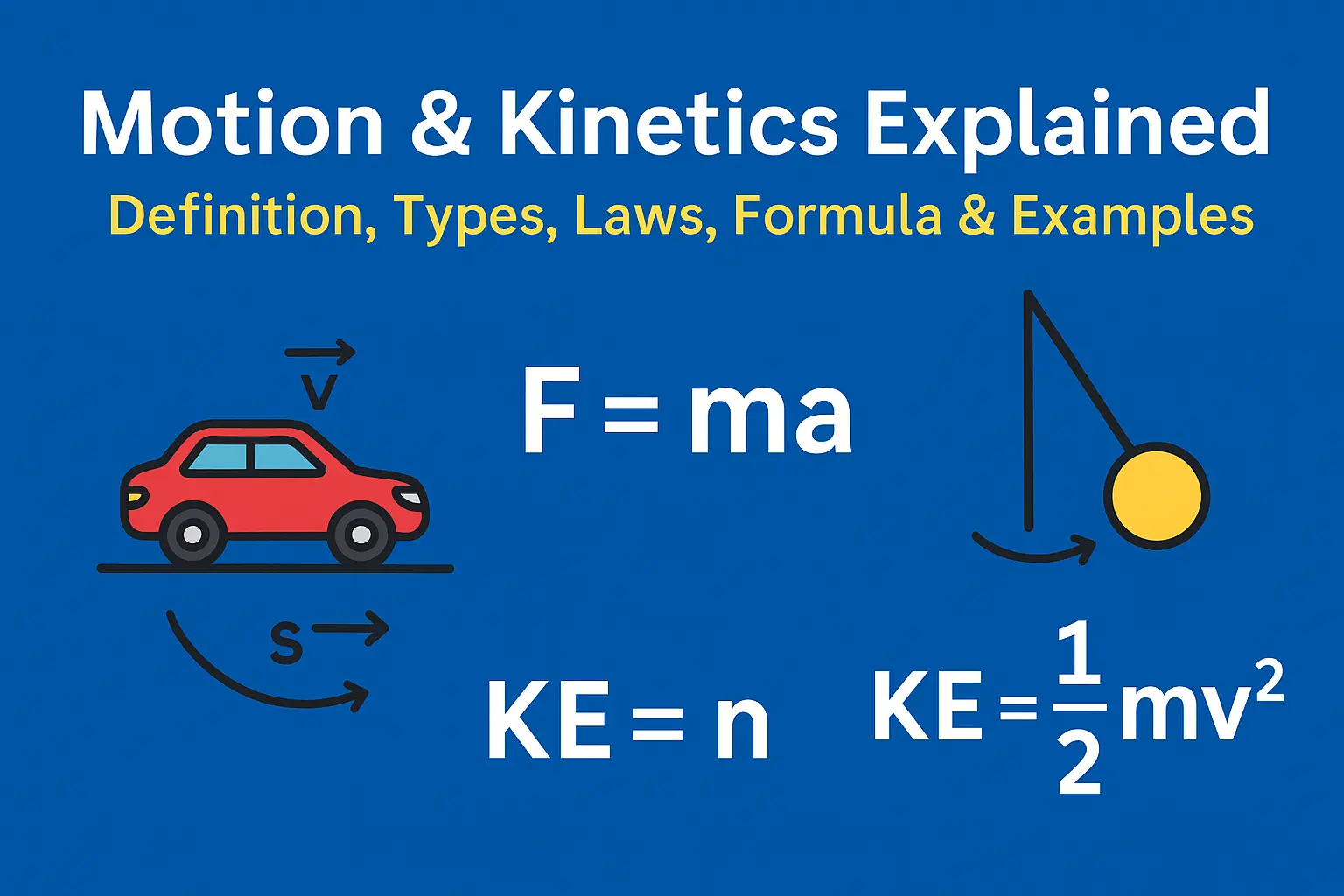
Motion & Kinetics Explained : Physics का सबसे important part है Motion & Kinetics, जो बताता है कि वस्तुएँ कैसे move करती हैं, किन वजहों से उनकी गति बदलती है और motion के पीछे कौन-कौन से forces काम करते हैं।
चाहे आप Class 9, Class 11 Physics, NEET/JEE की तैयारी कर रहे हों या फिर general science सीखना चाहते हों — ये chapter आपकी basics को बहुत मज़बूत बनाता है।
इस blog में हम Motion और Kinetics को समझेंगे — definitions, types of motion, speed-velocity-acceleration, Newton’s Laws, force, Kinetics energy, और numerical examples तक।
तो चलिए, शुरू करते हैं!
Motion & Kinetics Explained
1. Motion Kya Hota Hai? (What is Motion?)
Jab koi object apni position time ke saath change karta hai, toh hum kehte हैं कि वो motion में है।
Examples:
- Car ka road par move karna
- Train ka station se निकलना
- Fan ka घूमना
- Earth ka sun ke around घूमना
Daily Example:
Agar aap classroom me बैठे हों और fan छत पर घूम रहा हो → fan is in rotational motion, aap rest me हो।
2. Types of Motion (Gati ke Prakar)
Motion के कई प्रकार होते हैं, जो students को exam में भी बहुत helpful होते हैं।
1) Linear Motion (रेक्खीय गति)
जब कोई object straight line में move करता है।
Example:
- Road par चलती car
- Falling stone
- Running athlete
2) Circular Motion (वृताकार गति)
जब object एक fixed circular path में घूमे।
Example:
- Clock की सुइयाँ
- Merry-go-round
- Car turning in roundabout
3) Rotational Motion (घूर्णन गति)
Object अपने axis पर घूमे।
Example:
- Earth का rotation
- Spinning top
- Fan का घूमना
4) Oscillatory Motion (दोलीय गति)
Object बार-बार एक point के दोनों ओर move करे।
Example:
- Pendulum
- Swing
- Guitar strings का vibration
5) Periodic Motion (आवर्त गति)
Motion जो equal time interval में repeat होता रहे।
Example:
- Clock pendulum
- Heartbeat
- Earth का revolution
3. Distance vs Displacement
ये exam में MOST ASKED topic है।
Distance
- Total path covered
- Scalar quantity (only magnitude)
- हमेशा positive
Displacement
- Shortest straight-line distance
- Vector quantity (magnitude + direction)
- Zero भी हो सकता है
Example:
A person walks 3m forward, 3m back →
Distance = 6m
Displacement = 0m
4. Speed, Velocity & Acceleration
Speed
“How fast object moves”
Formula:
Speed = Distance / Time
Types:
- Uniform Speed – equal distance in equal time
- Non-uniform Speed – unequal distance in equal time
Velocity
Speed + Direction
(Example: 40 km/h East)
Formula:
Velocity = Displacement / Time
Also Read: Smart Study Ka Naya Tareeka – Study Saarthi ke Saath
Acceleration (त्वरण)
Velocity के change की rate
Formula:
a = (v – u) / t
जहाँ
u = initial velocity
v = final velocity
t = time
Example — brake लगाने पर car की speed reduce होती है → negative acceleration (retardation)
5. Newton’s Laws of Motion (न्यूटन के गति के नियम)
Sir Isaac Newton ने motion के 3 rules बताए, जो physics की foundation हैं।
Newton’s First Law – Law of Inertia
“Objects remain at rest or in uniform motion until external force is applied.”
Example:
- Table par पड़ी किताब तब तक नहीं हिलेगी जब तक आप उसे धक्का नहीं दें।
- Car अचानक रुकने पर passengers आगे की ओर झुकते हैं।
Newton’s Second Law – F = ma
Force = Mass × Acceleration
ये बताता है कि force object की acceleration को change करता है।
Example:
- खींचने पर cycle तेजी से आगे बढ़ती है
- ज़्यादा force → ज़्यादा acceleration
Newton’s Third Law – Action-Reaction
“Every action has equal and opposite reaction.”
Examples:
- Rocket launch (gases नीचे → rocket ऊपर)
- चलना (हम जमीन को पीछे push करते हैं → जमीन हमें आगे push करती है)
6. Force (Bal) & Types of Forces
Force वो interaction है जो object की motion change कराए।
Types:
A) Contact Forces
- Friction (रगड़) – motion oppose करता है
- Tension – rope में खिंचाव
- Normal Force – surface upward force
- Spring Force
B) Non-contact Forces
- Gravitational Force – Earth का खिंचाव
- Magnetic Force
- Electrostatic Force
7. Kinetic Energy & Potential Energy
Kinetic Energy (गतिज ऊर्जा)
Energy due to motion
Formula:
KE = ½ mv²
Example: चलती हुई car में kinetic energy होती है।
Potential Energy (स्थितिज ऊर्जा)
Energy due to position
Example:
- Height पर रखी किताब
- Stretched spring
8. Work & Power
Work (कार्य)
जब force से displacement होता है।
Formula:
Work = Force × Displacement
Power (शक्ति)
Work करने की दर
Power = Work / Time
Unit: Watt
9. Numericals (3–4 Solved Examples)
Numerical 1: Speed Calculation
A car travels 240 km in 4 hours.
Find speed.
Solution:
Speed = Distance/Time = 240/4 = 60 km/h
Numerical 2: Acceleration
A bike increases speed from 20 m/s to 40 m/s in 5 seconds.
Find acceleration.
Solution:
a = (v – u)/t
= (40 – 20)/5
= 20/5
= 4 m/s²
Numerical 3: Kinetic Energy
Mass of object = 5 kg
Velocity = 10 m/s
KE = ?
Solution:
KE = ½ mv²
= ½ × 5 × (10)²
= 2.5 × 100
= 250 Joules
Numerical 4: Distance under acceleration
u = 0, a = 5 m/s², t = 4s
Find distance.
Formula:
s = ut + ½at²
= 0 + ½ × 5 × 16
= 2.5 × 16
= 40 meters
10. Real-life Applications of Motion & Kinetics
- Cars में braking
- Aeroplanes का takeoff
- Sports में ball की speed
- Roller-coaster rides
- Rockets और satellites का launch
- Bridges, lifts and machines का काम
ये सभी motion, force और energy के principles पर based हैं।
Conclusion
Motion और Kinetics Physics का सबसे fundamental और interesting topic है। इसमें हम सीखते हैं:
- Objects कैसे move करते हैं
- Speed, velocity और acceleration कैसे change होते हैं
- Forces motion को कैसे affect करते हैं
- Newton’s laws real-life में कैसे काम करते हैं
- Energy objects को move करने में कैसे help करती है
Also Read: Board Exam 2025 Smart Study Plan – 10 Tips Jo Har Student Ko Follow Karni Chahiye